 Copy URL to Clipboard
The Food Traceability Rule of the Food Safety Modernization Act (FSMA) obligates manufacturers and processors of certain foodstuffs to record Critical Tracking Events (CTEs) during the harvesting, processing, and storage process to provide the Food and Drug Administration (FDA) with easy-to-access information about an affected product’s journey from the farm to the tables of U.S. citizens.
The FSMA Food Traceability Rule (FTR) is the mechanism by which Section 204(d) of the FSMA is executed. It applies to manufacturers, processors, packers, and distributors of foodstuffs that appear on the FDA’s Food Traceability List (FTL).
This rule is separate from the FSMA’s Sanitary Transportation Rule already in effect.
The original Food Traceability Rule compliance date was January 20, 2026. FDA later proposed extending that date by 30 months to July 20, 2028, and Congress directed FDA not to enforce the rule before July 20, 2028.
Shippers can use the time between now and the 7/20/28 implementation date to identify which products they offer are affected by the rule and build data-sharing strategies with their partners throughout the supply chain. Consulting with a logistic professional during this process provides an added level of assurance that those strategies will be data driven, thoroughly documented, and able to withstand FDA scrutiny.
The FTR applies to specific types of produce, dairy products, seafood, and composite goods that contain those ingredients. Affected foodstuffs are listed on the FTL, with notable exceptions and specific requirements stated as well.
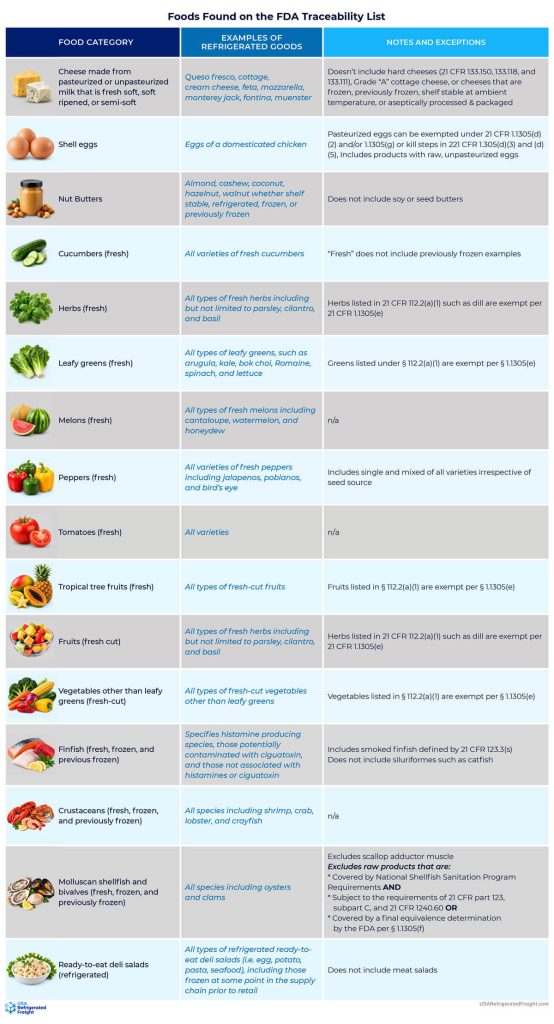
The FTL doesn’t cover every refrigerated foodstuff, but its applications aren’t always obvious to shippers.
No, not all shipments of refrigerated food trigger FTR requirements. However, the foods to which the FTR does apply can be used as ingredients in aggregate food products that might not be as obvious to shippers. Under this circumstance, refrigerated foods may or may not be subject to the FTR depending on the exemptions mentioned in the previous table.
Within supply chains, a Critical Tracking Event (CTE) is an event to which the FTR applies specific traceability information requirements.
The FTR identifies seven CTEs for affected foods:
For each of these CTEs, the FDA lists Key Data Elements (KDEs) that must be recorded.
Shippers are required to record the KDEs associated with shipping affected foodstuffs, which are:
Shippers are given some latitude in the manner they choose to retain these documents.
Tom Aumann, R+L's Vice President of Flatbed and Over-Dimensional Services offers the following advice to affected shippers:
“Make sure all the information is in front of you and kept intact. It’s data accumulation: what were the temperatures the product was held at and exposed to, what were the handling requirements, and who had access to the shipment? As the product moves, it accumulates data like a snowball rolling downhill, and that snowball of information needs to stay cohesive even as it grows larger until the shipment reaches the end user."
No. While the information that applies to food traceability and food transportation are related, they aren’t identical and BoLs don’t have to contain traceability records, though shippers do have the option of fulfilling maintenance record requirements via Bills of Lading.
Other documents shippers could use for this purpose include but aren’t limited to:
While the BoL doesn’t have to contain traceability records, that information does have to be recorded and maintained by the shipper.
Shippers must maintain FSMA traceability records for two years per Section 204, which authorizes the FDA to require document retention for no more than that amount of time. The records must also be readily available. If the FDA requests required traceability records, covered entities generally must provide them within 24 hours of the request, or within another reasonable time agreed to by the FDA.
Shippers of refrigerated foodstuffs can prepare for the Section 204 recordkeeping requirements of the FSMA by identifying the following data elements:
If you’re a shipper looking for a logistics partner with a proven record of refrigerated freight shipping compliance, call our team of experts at (866) 849-4923 or contact us online today.
Food Traceability Rule: Critical Tracking Events (CTEs) and Key Data Elements (KDEs), U.S. Food and Drug Administration
USA Refrigerated Freight
315 NE 14th Street #4122
Ocala, FL 34470
