 Copy URL to Clipboard
Key Takeaway:
Reefer trailer documentation helps shippers protect perishable freight, communicate temperature requirements, and support cold-chain compliance. This guide explains what shippers should provide before pickup, how reefer temperature instructions should be documented, and which mistakes commonly lead to spoilage or freight claims.
A reefer trailer is a refrigerated shipping unit that maintains controlled conditions for perishable goods. To ship on a reefer trailer, shippers must provide temperature requirements, use sanitary loading practices, pre-cool the trailer when needed, supply shipping documents, and communicate monitoring instructions that support Food Safety Modernization Act (FSMA) compliant transport.
Reefer trucks deliver perishable goods such as:
The U.S. Food and Drug Administration (FDA) is a federal agency that enforces FSMA. The FSMA Final Rule on Sanitary Transportation of Human and Animal Food requires carriers to maintain safe temperature ranges during transit.
FSMA requires carriers, manufacturers, and shippers who load and unload sensitive freight to follow these regulations:
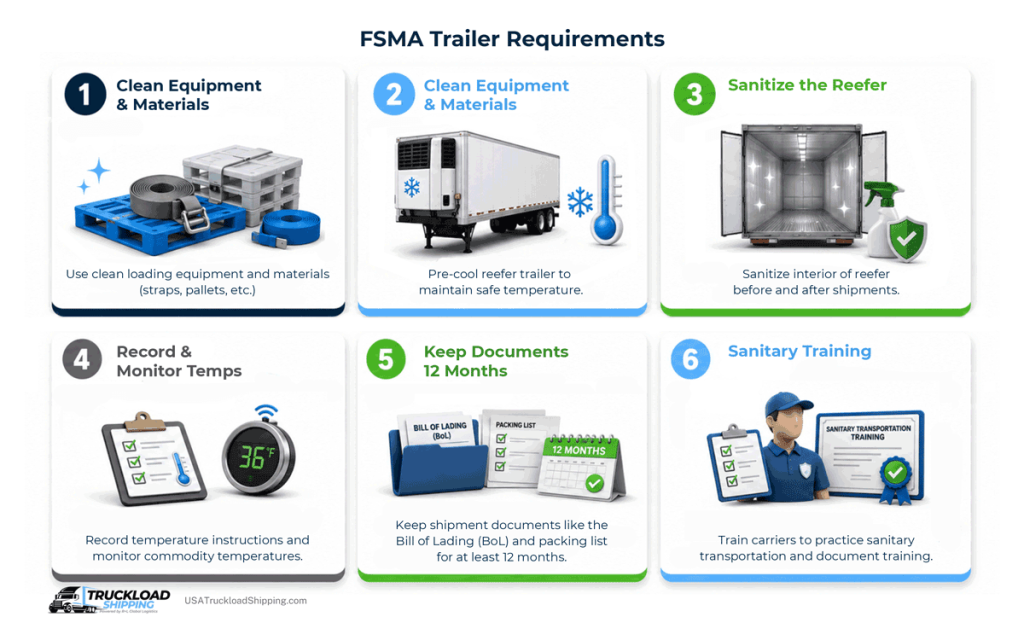
According to the FSMA Final Rule, improper temperature control is one of the leading causes of foodborne contamination during transport.
To protect perishable freight and stop foodborne contamination, use the following reefer trailer protocols.
Reefer trucks should be pre-cooled at least 30 minutes before loading freight. This process prevents temperature shock and condensation, and protects freight by maintaining a steady temperature from load to unload.
Reefer trailer temperatures range from -20°F to 80°F. Required reefer temperatures vary by product, packaging method, and shipper instructions. Carriers should follow the shipper’s documented set point and any commodity-specific handling requirements.
We’ve created a chart of common temperature-sensitive commodities and their shipping temperature ranges.
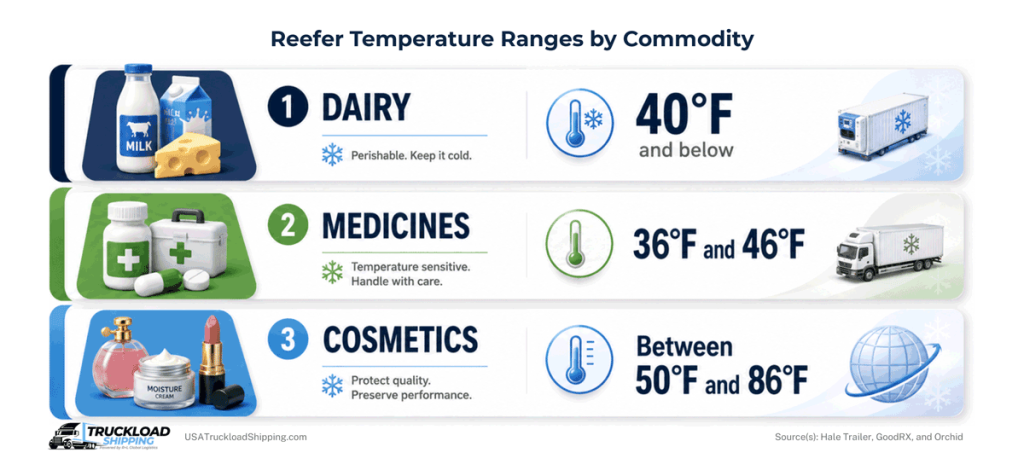
Source(s): American Dairy Association North East, GoodRx, and Orchid
Pre-cooling and maintaining the required set point helps protect cargo from temperature-related damage like spoilage and other contamination.
Reefer handling notes should state the required temperature range, monitoring method, logging frequency, product details, and shipment documents. Clear handling notes reduce spoilage risk, support compliance, and help carriers maintain proper conditions from pickup through delivery.
When shippers schedule a freight pickup appointment, they must include handling notes to protect their goods every step of the shipping process.
Provide your carrier with these notes to ensure pickup and delivery complies with FSMA safe transportation.
Like FSMA, the Federal Motor Carrier Safety Administration (FMCSA) is an agency of the U.S. Department of Transportation (DOT) that oversees safe freight transportation. This checklist helps carriers handle goods accordingly and remain compliant with FMCSA regulations audited and monitored through the FMCSA SAFER system, a U.S. government database that collects and displays carrier safety ratings and compliance for shippers to verify.
Once your carrier knows how to handle your temperature-controlled freight and you’ve verified they are FSMA and FMCSA compliant, it’s time to load up and monitor freight.
Shippers manage reefer trailer temperature in start-stop mode or continuous mode. Specify which mode the carrier should use based on the cargo’s temperature sensitivity, transit length, and risk of temperature fluctuation.
“Start-stop” is a reefer mode that automatically shuts down and turns on the trailer’s refrigeration unit at scheduled time intervals to maintain core temperature and preserve vehicle fuel.
Continuous mode runs the refrigeration unit throughout transit to maintain a stable trailer temperature, with higher fuel use.
Shippers must inform their carrier if freight needs continuous cooling during transit or if it can withstand minor temperature shifts with start-stop mode. This communication helps shippers avoid risk of damage, federal noncompliance, and accessorial charges like a fuel surcharge.
A fuel surcharge is an accessorial charge carriers apply to a shipper’s freight bill to offset volatile market oil and diesel prices. While this is a standard cost of freight shipping, carriers may increase their fuel surcharge for continuous reefer mode since it requires more fuel consumption to keep freight cool in transit.
According to the International Air Transport Association (IATA) temperature-controlled goods handling tips, packaging must be labeled and marked with handling directions.
While the IATA is a trade association for global airlines, representing 84% of the world’s air traffic, these labeling guidelines are practical for truckload shipping for both shippers and carriers to comply with federal transportation regulations.
Shippers that fail to properly label goods with required temperature-control, fragile, or hazardous markings, or that use inadequate packaging for sensitive products, risk violating FMCSA and other applicable regulatory requirements.
Domestic freight shipments require complete documentation before loading, including any instructions needed for the carrier to handle the shipment correctly.
Your commodity may come with specific temperature requirements and shipping instructions. Failing to provide monitoring instructions can create uncertainty about the reefer set point, the logging method, and how often temperatures should be checked and recorded.
Shippers that handle sensitive or high-value temperature-controlled freight may need more detailed documentation, carrier instructions, and monitoring procedures than a standard shipment requires.
If managing reefer temperature documentation is causing compliance risks or shipment delays, our freight consultants can help you streamline monitoring, documentation, and carrier coordination.
We work with you to simplify your business’s cold chain logistics. Call our freight experts at (866) 849-4923 or request a quote today.
Sources:
FSMA Final Rule on Sanitary Transportation of Human and Animal Food, FDA, 2018
SAFER WEB, FMCSA
NMFC and Freight Class, NMFTA
Tips on How to Handle Temperature-Controlled Goods to Maintain Product Integrity, IATA, 2022
In Depth Guide to Understanding Truck Reefer, American Mortuary Equipment, 2025
Dairy Temperature Chart, American Dairy Association North East, 2017
Christodoulopoulos, Giana, Medication Storage: Temperature Guidelines and How to Deal with Hot and Cold Excursions, GoodRx, 2025
Moore, Ava, How to Store Cosmetic Raw Materials Properly?, Orchid Chemical, 2025
USA Refrigerated Freight
315 NE 14th Street #4122
Ocala, FL 34470
