 Copy URL to Clipboard
Key Takeaway:
A dry van is a trailer used for non-perishable freight, while a reefer is a specialized trailer required for temperature-controlled goods. The key difference between a dry van vs reefer is temperature control, cost, and compliance requirements under Federal Motor Carrier Safety Administration (FMCSA) and Food Safety Modernization Act (FSMA) regulations. Choosing the wrong trailer can lead to spoilage, rejected loads, or regulatory violations.
A dry van is an enclosed semi-trailer used to haul non-perishable freight. Businesses use dry vans to haul:
Dry van trailers protect freight from weather elements like rain, snow, and heat but are not suitable for temperature-controlled goods that can spoil in those weather conditions.
A reefer is a refrigerated, enclosed semi-trailer used to haul perishable freight. Businesses in cold chain logistics use reefers to transport:
Shippers choose dry vans for non-perishable freight and reefers for temperature-controlled loads in LTL, FTL, and expedited shipping.
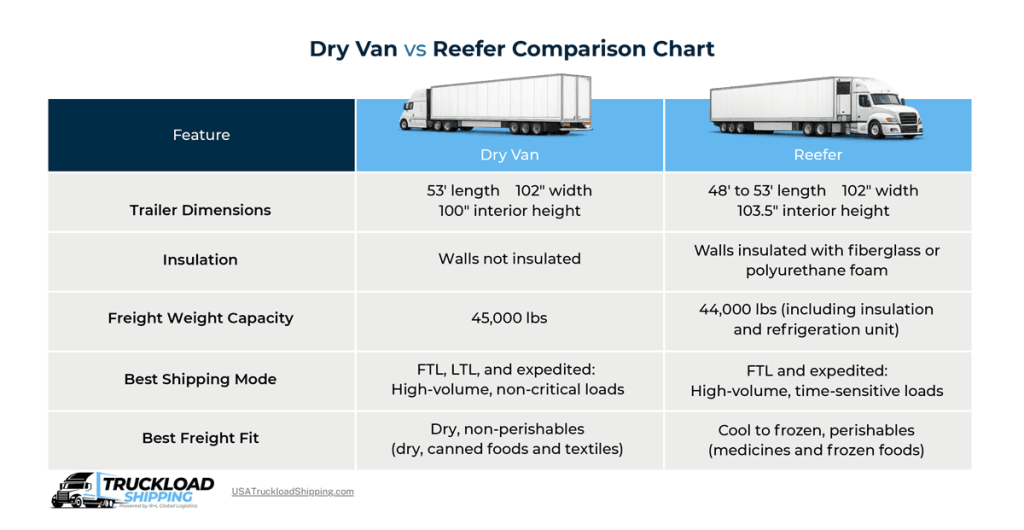
The chart below further illustrates the differences between dry vans and reefers.
Use dry vans when:
Use reefer when:
In the next section, we’ll discuss the federal requirements for food safety transit and when a reefer trailer is required to protect freight.
Since reefer trailers are used to ship temperature-controlled freight and preserve its quality, there are various federal regulations in place to safely ship perishable cargo.
The FMCSA enforces temperature control and sanitation standards under 49 CFR Part 393, which applies to both dry van and reefer shipments. These regulations include transportation safety guidelines that pair with the Food and Drug Administration’s (FDA) efforts to protect food shipments and reduce foodborne illnesses.
The FDA created the Food Safety Modernization Act (FSMA) law for the Sanitary Transportation of Human and Animal Food. Shippers and carriers must follow FMCSA and FSMA regulations for both reefer and dry van.
Reefers are generally more expensive than dry vans because they’re equipped with insulation and refrigeration units that require additional, routine maintenance to function.
Dry van and reefer costs are priced per mile to use. Shippers can use tools like DAT National Van Rates, a freight analytics database, to check trailer rates in their region.
We’ve made a chart showing the national average dry van vs reefer rates:

Note: The rates provided are directional averages from DAT and vary by lane, season, equipment availability, and fuel costs. Add the date and source link for the rate snapshot.
Dry vans are also less expensive than reefers because dry vans are more widely available. Reefers carry approximately 1,000 lbs less freight due to insulation and cooling units, which directly impacts cost per load.
First time shipping? Use our checklist to prepare your load and select the right trailer to fit your freight.
Follow our step-by-step guide to get your freight ready for the appropriate shipping mode:
Whether you’re working with a freight broker or 3PL company to book your load, this checklist will help you choose between a dry van or reefer to protect your freight in transit.
If you’re not sure whether your freight requires temperature control on a reefer or if it will ship safely on a dry van, use our checklist to match your load to the right shipping mode.
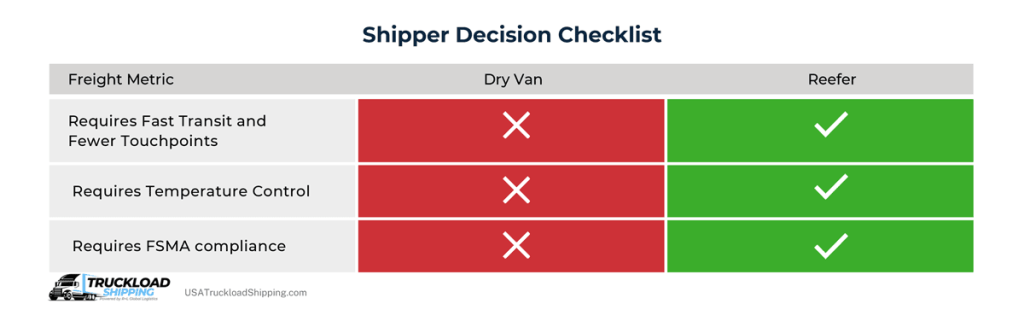
While there are federal requirements for dry van shipments, businesses moving freight that’s temperature-sensitive must use reefers to comply with FSMA requirements.
Choosing the wrong trailer increases spoilage risk, claims, and compliance issues. If you are unsure whether your shipment needs active temperature control, our freight team can review your commodity, route, and handling requirements before you book.
Call (866) 849-2713 to find the correct mode for your next load or get a reefer quote today.
Sources:
FMCSA Regulations and Interpretations - 49 CFR Parts 300-399, Federal Motor Carrier Safety Administration
FSMA Final Rule on Sanitary Transportation of Human and Animal Food, U.S. Food & Drug Administration,
Trendlines - National Van Rates, DAT Freight & Analytics, 2026
USA Refrigerated Freight
315 NE 14th Street #4122
Ocala, FL 34470
