 Copy URL to Clipboard
Refrigerated freight rates are the costs to ship temperature-sensitive freight. This can include items like produce, pharmaceuticals, and chemicals. Shipping rates for this type of freight can fluctuate on a weekly-basis due to various logistics and market factors. Understanding what affects refrigerated freight rates will help you accurately budget your shipping expenses and optimize your supply chain.
Factors that affect refrigerated freight rates include:
We’ll explain how each influences refrigerated freight rates in the next section.
The distance a shipment has to travel, whether refrigerated or not, will affect your shipping rates. Longer distances typically correlate to higher rates for your shipments. You’ll also have to take into account the time-sensitivity of your refrigerated goods.
Products like produce have an expiration date, even if they’re refrigerated. The urgency of your shipment combined with the distance it has to travel can result in a more expensive rate.
Produce season increases the demand for reefer trailers. A reefer trailer is a trailer that’s used to transport temperature-sensitive freight like fruits and vegetables. When produce is harvested in major growing regions like California, the Midwest, the Southern U.S., and along the U.S.-Mexico border, thousands of seasonal loads enter the market.
The increase in temperature-sensitive loads tightens capacity for reefer trailers and raises shipping rates. Produce seasons vary based on the time of year and geography. As shipments of fruits and vegetables in one region decrease, produce shipments will rise in other areas of the country.
This means demand for reefer trailers will shift, causing capacity constraints and refrigerated shipping rates to fluctuate from region to region.
The availability of reefer trailers affects your refrigerated shipment. There are already fewer reefer trailers available compared to dry vans, which makes them more sensitive to capacity constraints. If reefer capacity shrinks, carriers will charge higher prices. As more reefers become available, refrigerated shipping rates decrease.
The United States Department of Agriculture (USDA) provides a Refrigerated Truck Dashboard to help shippers track availability.
Fuel prices, specifically diesel, is one of the most common operating expenses in the logistics industry. Diesel prices fluctuate due to geopolitical tensions, refinery and pipeline disruptions, and crude oil supply shifts. The price of diesel can also vary between regions in the United States.
Carriers recover fuel price increases with fuel surcharges or higher freight rates. Unfortunately, refrigerated shipments are especially susceptible to rising fuel costs. The refrigeration units on a reefer trailer also consume fuel to function. This means refrigerated shipments consume more fuel, thus raising your costs.
Not all refrigerated freight can be kept at the same temperature. Some goods must be shipped frozen or maintain a narrow temperature range, while others only need standard refrigeration.
More demanding temperature requirements increase the amount of fuel consumed by reefer units, which results in higher transportation costs.
Broader freight market conditions can influence refrigerated freight rates as well.
This includes:
Refrigerated freight is volatile to these conditions because it serves time-sensitive industries like agriculture, food distribution, and the medical field. Unexpected events can rapidly alter supply and demand for goods in these respective industries.
In addition to standard shipment details like origin and destination, weight, dimensions, and handling requirements, you’ll need to provide the required temperature for a carrier to accurately calculate your refrigeration freight rates. We’ve provided a table of each piece of information you’ll need to provide and why they’re important.
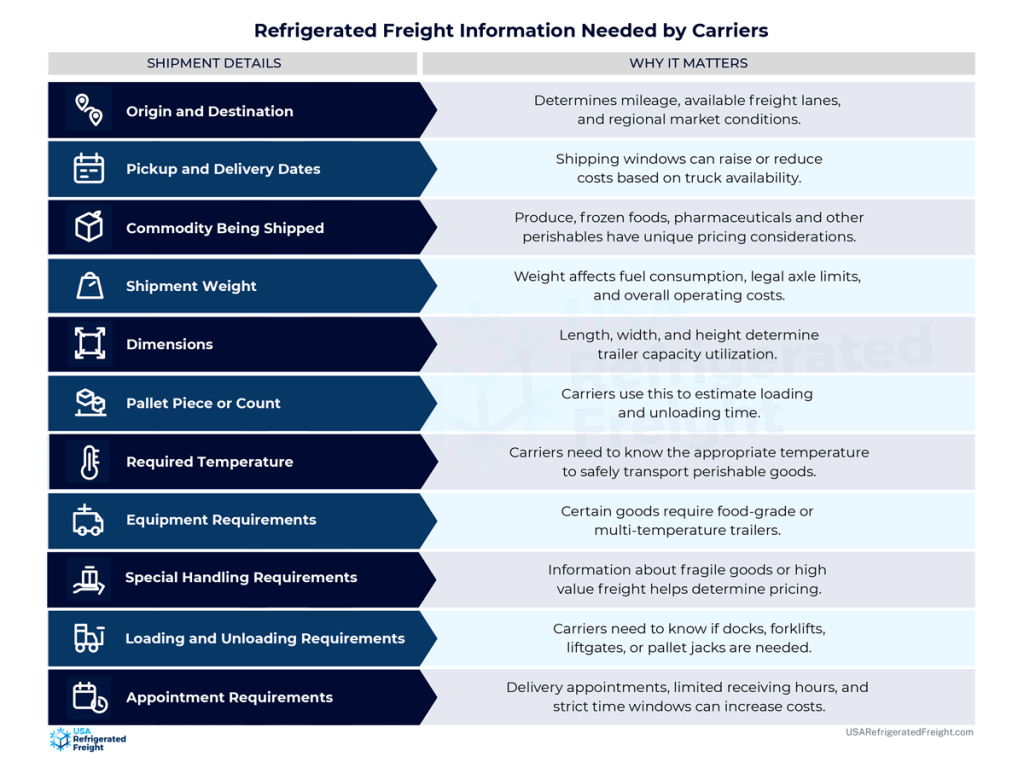
Since reefer rates are typically more expensive, ensuring you have the right information so your carrier can give you an accurate rate is essential.
Shippers of refrigerated freight can lower their costs by consolidating shipments, reducing dwell times, and improving shipment forecasting.
Here’s how each one works:
Using these methods will not only help you lower your refrigerated freight rates, but also help improve your logistics networks.
Mistakes that can raise your refrigerated shipping costs include booking freight at the last minute, providing inaccurate shipment information, ignoring cold chain best practices, and requesting a colder temperature than necessary. We’ve provided a graphic to give you more information about how these mistakes can increase your expenses.
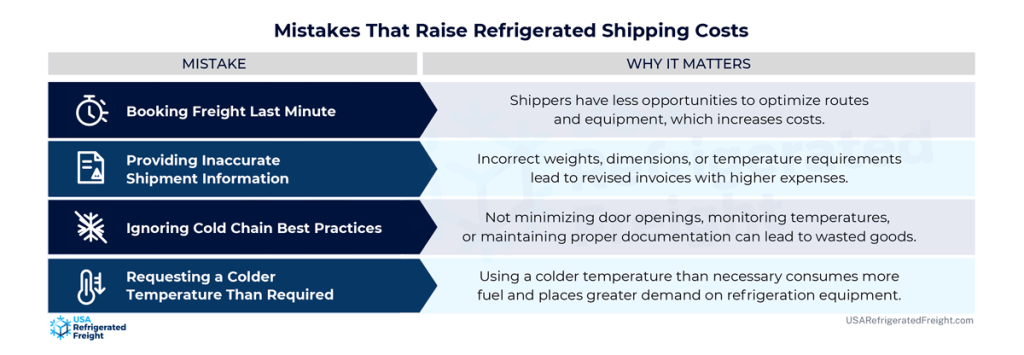
The biggest mistake you can make is shipping refrigerated freight with an unreliable carrier. USA Refrigerated Freight has a trustworthy network of carriers with the driver and reefer units you need to transport your perishable goods. Fill out your quote today or contact us at (866) 849-4923 for more information about our services.
Sources:
19 Crops That Are Grown Only in California, CA Grown Blog, 2023
Refrigerated Truck Dashboard, United States Department of Agriculture, 2026
USA Refrigerated Freight
315 NE 14th Street #4122
Ocala, FL 34470
