 Copy URL to Clipboard
Reefer tender rejection occurs when a refrigerated freight carrier declines a shipment offered by a shipper, typically under an existing transportation agreement. Rejections can result from limited refrigerated trailer availability, unfavorable freight rates, or scheduling conflicts. For businesses shipping temperature-sensitive products, rejected tenders can lead to higher transportation costs, delayed shipments, and a higher risk of product spoilage.
A reefer load tender is a formal request for a carrier or third-party logistics (3PL) provider to transport refrigerated freight under specified terms. The transportation provider reviews the shipment details and decides whether to accept or reject the load.
After a carrier refuses a shipment, the shipper must find another transportation provider to move their freight.
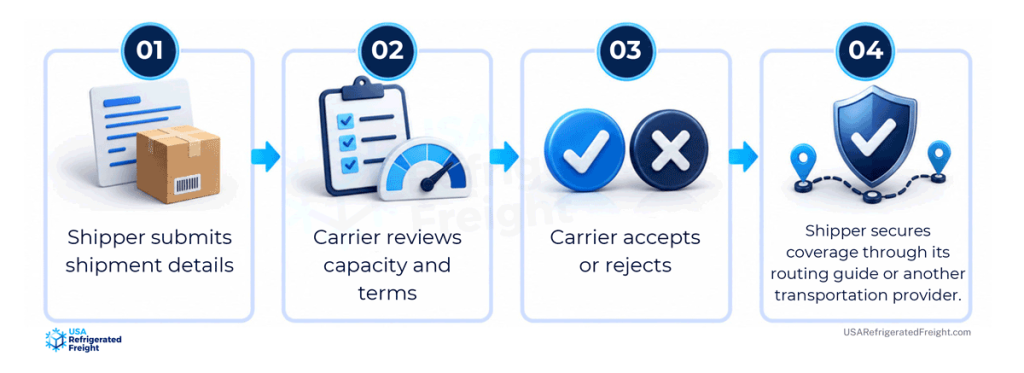
The reefer freight tendering process starts when a shipper submits shipment details to a carrier or 3PL. The transportation provider reviews their capacity and contractual agreement with the shipper, if one has been established. The carrier or 3PL either accepts or rejects the tender.
If accepted, the shipper has successfully secured capacity for their perishable goods. If the transportation provider rejects the tender, the shipper will have to secure capacity elsewhere. Here’s a graphic that better illustrates the process.
Freight market analysts use tender rejection rates to assess carrier availability and market conditions. SONAR has identified a 5%-7% national truckload tender rejection range as a sign of relatively balanced freight market conditions.
That said, reefer rejection rates can vary by season, geographic market, and shipping lane. Businesses should evaluate their own rejection rates against historical performance, contractual expectations, and current market conditions.
Rates can be calculated by dividing the number of offers rejected by the total number of load tenders issued over a given period, then multiplying it by 100.
The calculation should look like this:

As an example, if carriers reject 15 of 100 refrigerated load tenders, the rejection rate is 15%.
Industry reefer tender rejection rates are monitored by the FreightWaves SONAR. SONAR is a platform that provides businesses in the supply chain with freight market intelligence. There are two metrics that SONAR uses to measure refrigerated freight rejection.
These includes:
There are variants of the ROTRI and RITRI that measure reefer tender rejection rate changes on a weekly, biweekly, monthly, and annual basis.
A high reefer tender rejection rate indicates that refrigerated carriers are less likely to accept contracts for new shipments. It can signal tighter equipment availability, stronger demand for reefer transport, or contract rates that aren’t as appealing to more lucrative loads.
These conditions can increase the risk of rejected tenders and create additional spot-market pricing pressure.
Reefer carriers reject tenders primarily because of limited capacity, below market contract rates, seasonal demand, strict temperature requirements, pickup and delivery scheduling conflicts, and weather disruptions.
Carriers reject tenders when they don’t have the reefer units available to accept new shipments. Since there are more dry van trailers than reefer units, refrigerated carriers are more susceptible to capacity constraints. As a result, tender rejection rates for refrigerated freight shipments are typically higher.
Contract rates keep shipping costs consistent. While this is good for shippers, it can cause carriers to lose out on profits if current market rates are higher. Reefer carriers might reject a shipment for better-paying loads.
Seasonal demand can affect reefer unit capacity. For example, produce season can cause reefer tender rejection rates to increase as agricultural producers compete for temperature-controlled equipment to transport freshly harvested products. This can constrain reefer unit capacity during harvest seasons.
Reefer carriers might reject tenders if a pickup or delivery request conflicts with their existing commitments.
Common scheduling problems include:
Tenders that provide more lead time and flexible appointments allow carriers to coordinate their resources more effectively.
Severe weather can also lead to rejected reefer tenders. If weather events like hurricanes, winter storms, and flooding are affecting certain regions, refrigerated carriers will be reluctant to transport freight to those areas.
Severe weather can also delay shipments, which increases the chances of perishable freight spoiling. Reefer carriers don’t want to take responsibility for freight they might lose to this risk.
Reefer tender rejection can increase freight costs, delay shipment pickups, increase the risk of spoilage, and create supply chain disruptions and customer service problems.
When a contracted reefer carrier rejects a shipment, the shipper will need to contact backup carriers or secure capacity through the spot market. During periods of limited refrigerated equipment availability, spot rates can exceed contracted rates, increasing the cost of moving temperature-sensitive freight.
Shippers organize their warehouse schedules, receiving appointments, and delivery commitments around the expectation that their contracted carrier will accept their reefer tender. When their carrier declines a shipment, shippers have to scramble for a new carrier. This can lead to delayed pickups and deliveries.
Two of the biggest risks facing refrigerated freight are spoilage and temperature excursion. Spoilage is when perishable products deteriorate and become unsuitable for their intended use.
Temperature excursion is any event in which a temperature-sensitive product experiences a temperature outside its approved range for any length of time.
While tender rejection doesn’t directly cause spoilage or temperature excursion, it can lead to extended handling and storage conditions that increase the risk of both events. Shippers have to move fast and handle their goods with care until they can find a carrier to fill in for the one that rejected their tender.
Rejected reefer tenders can cause supply chain disruptions and customer service problems. Grocery stores, pharmacies, and hospitals all require perishable goods to sell or use. Reefer tender rejection delays shipments, which can stall the replenishment of valuable perishable goods.
This can lead to inventory shortages and consumers without the perishable foods and medicines they require. What started as a simple rejected tender can turn into a disruption in the cold chain.
There are steps that shippers can take to keep their tender rejections between 5% and 7%, such as:
We’ll explain how these strategies improve tender acceptance rates.
Booking freight early gives carriers the time they need to allocate the equipment required to move a shipment. This is especially important for refrigerated carriers since they’re more likely to face capacity constraints. Shippers should provide as much notice as possible, particularly during produce season or when specialized temperature-control equipment is required.
The purpose of contract rates is to guarantee shippers predictable shipping costs. That said, carriers may reject tenders if the rates in a contract are well below current market rates. Shippers should be open to renegotiating their contract rates when the market shifts drastically.
They don’t have to agree to rates that are absurdly high, but they can negotiate a rate that’s competitive and worthwhile for their reefer carrier.
Reefer freight is more fragile than other types of cargo. Therefore, refrigerated carriers need accurate information about the freight they’re transporting. Vague or inaccurate details can lead to tender rejection.
Shippers of reefer freight should provide the following information about their freight:
This information helps carriers understand what they’re transporting and the equipment they’ll need.
Reefer carriers run on their own schedules. If a tender specifies a pickup or delivery time that doesn’t work for them, they’re more likely to reject it. Shippers that provide flexible pickup and delivery windows give carriers the ability to pick times that are best for them.
Carriers favor shippers that provide them with consistent freight volumes, driver-friendly facilities, low detention times, and familiar lanes. Shippers that prove themselves to be reliable partners that make doing business easy for carriers are less likely to get their tenders rejected.
There’s no time to hesitate when a shipper’s reefer tender is rejected by their carrier. A shipper will need to act fast to get their freight moving. We’ve compiled a table showing the next steps that should be taken.
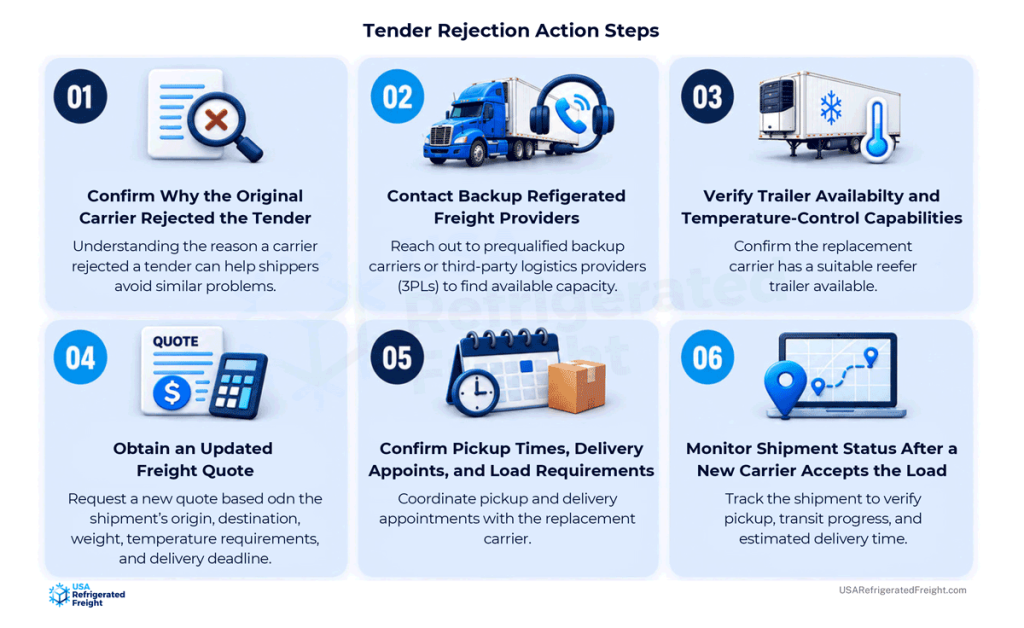
Moving through these steps quickly is essential to reducing disruptions caused by reefer tender rejection.
If your refrigerated freight tender was rejected or you need to arrange an upcoming shipment, request a reefer shipping quote from USA Refrigerated Shipping. Provide your shipment details to explore available transportation options. We have a vast network of vetted refrigerated carriers that will transport your perishable goods with speed and accuracy. You can also contact our team at (866) 849-4923 if you have any questions.
USA Refrigerated Freight
315 NE 14th Street #4122
Ocala, FL 34470
